
Pour tout système hydraulique, les fluides sont le composant le plus critique !
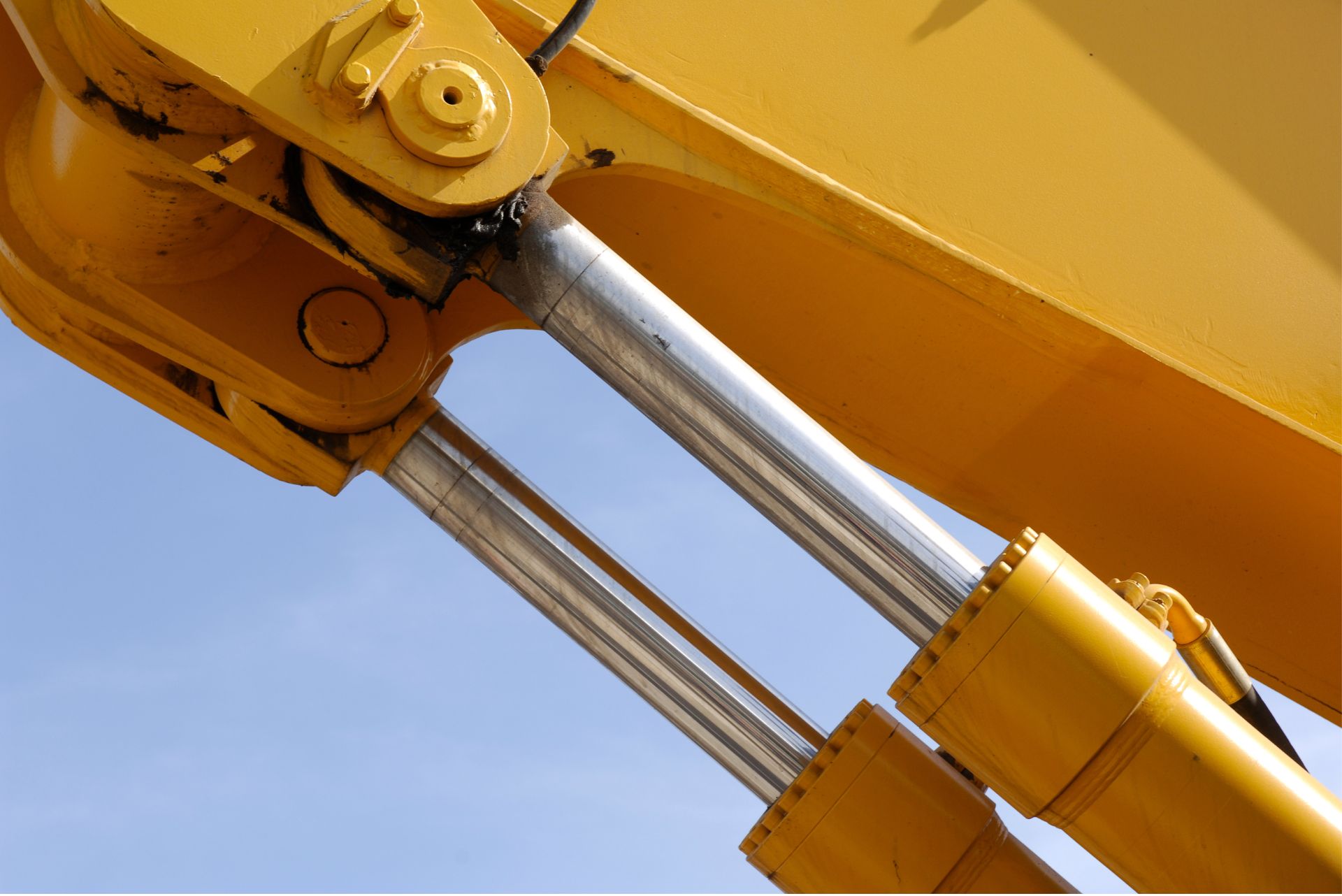
For fluid power applications, the primary distinguishing element is that fluids are present, which is the case with hydraulics and pneumatics. Hydraulic fluid is also required for each operation in a hydraulic system. If you’re asking what is hydraulic fluid, it’s the medium that transmits power, lubricates components, and protects the hydraulic system so it can operate safely and efficiently.
To move energy from one area of the system to another, hydraulic systems require incompressible hydraulic fluids, often known as hydraulic oils or liquids. Fluids are kept in a reservoir and are drawn up by a pump that moves them through the pipes to other components during hydraulic system operation.
In addition to choosing the right type of hydraulic fluid, keeping the fluid level within the recommended range is essential for performance and safety. Issues caused by low hydraulic fluid symptoms, like overheating, sluggish operation, pump damage, or full system failure, can quickly escalate if not addressed. Operators should regularly check fluid levels and fix any leaks before they become costly repairs.
Continue reading this article to understand what hydraulic fluid is for and the key characteristics of hydraulic fluid that influence performance.
Characteristics of Hydraulic Fluid
1. Viscosité
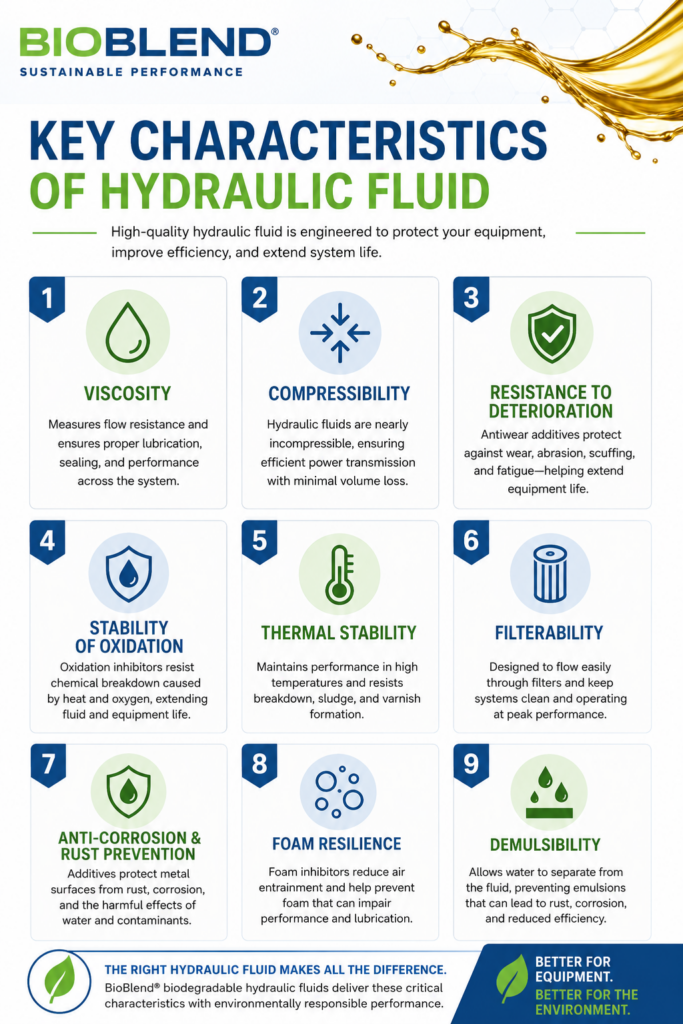
The viscosity of hydraulic fluid measures flow resistance. It is the essential property of hydraulic fluid and substantially impacts the system’s performance.
Sealing is compromised when the hydraulic oil is too thin or too viscous. As a result, there is a risk of leaks and part wear. Viscosity in hydraulic oil also affects how easily it can be pumped through the system, which can hurt performance if it is outside the recommended range.
2. Compressibilité
La compressibilité indique combien de volume est réduit lorsqu'il est soumis à une contrainte. Une légère perte de volume peut se produire même si les huiles hydrauliques sont essentiellement incompressibles.
3. Résistance à la détérioration
Hydraulic fluid can minimize the rate at which it wears out in frictional boundary contact. Metal surfaces can be shielded against abrasion, scuffing, and contact fatigue with the antiwear components found in antiwear hydraulic fluids. Improved lubricant performance and longer equipment life can be achieved by using antiwear additives.
4. Stabilité de l'oxydation
Heat-induced deterioration is caused by chemical reactions between oxygen and hydraulic oil. Additives that prevent oxidation, increase the fluid’s stability, and extend its life are required in hydraulic oils. You should expect the hydraulic oil to lose its quality rapidly if you don’t use these additives.
5. Thermal Stability
Thermal stability refers to a material’s capacity to withstand high temperatures without breaking down. At increasing temperatures, the degradation of antiwear additives is accelerated. Sludge and varnish can clog filters, reduce flow, and lengthen downtime due to poor low-temperature stability.
6. Filtrabilité
Hydraulic fluid additives can react with water to produce an oil-insoluble substance. These impurities can precipitate from the lubricant and obstruct oil flow or cause the system to be bypassed. Unanticipated downtime is a possibility if a blockage persists. Filtration of hydraulic fluids in modern systems poses no threat to the additive because of the design of the fluids.
7. Anti-corrosion et prévention de la rouille
Water can interact with hydraulic oil in many systems by condensation or contamination. Hydraulic components might corrode if they come into contact with water. In addition, some additives can react with water to generate chemical species that can harm yellow metals when combined. In hydraulic oil compositions, corrosion and rust inhibitors prevent water and other chemical species from interacting with the metal surfaces.
8. Foam Resilience
When air or other gases are entrained into the hydraulic fluid, it foams. The reservoir or air leaks inside the hydraulic system are the two main entry points for air into the system.
Large amounts of dissolved or dispersed air bubbles can be found in hydraulic fluids under high pressure. Depressurization causes bubbles to expand and create foam. Foam can significantly impact machinery performance and lubrication due to its compressibility and poor lubricating characteristics. Because they reduce air bubble surface tension, suitable foam inhibitors help break up foam faster.
9. Désémulsibilité
Hydraulic oil can emulsify or combine with water that enters the system. Using this “wet” fluid might lead to corrosion and rust if circulated through the system. Mineral oils that have been significantly refined allow water to separate or demulsify more easily. Hydraulic oils, on the other hand, often contain additives that cause emulsion formation, preventing water from dissolving and settling out of the fluid.
Top 5 Reasons Hydraulic Fluid Is Important
Les huiles hydrauliques ont un impact significatif sur la productivité du système. Les systèmes hydrauliques sont souvent conçus pour des applications à grande vitesse, haute pression et haute température. Une défaillance prématurée du système peut être évitée en analysant et en entretenant adéquatement l'huile.
The task at hand determines the type of hydraulic fluid used. The perfect hydraulic fluid has a few characteristics. For example, lubrication and de-aeration, the ability to release water (demulsibility), chemical and environmental stability, fire resistance, low flammability, foam resistance, and low volatility are all included.
1. Production d'énergie
The principle of Pascal’s law underlies the operation of every hydraulic system. For a process to be completed, an incompressible fluid must be present in the system that can transmit energy from one location to another. At the point of limitation, pressure builds up as a result of the flow being initiated by the pump. Force multiplication and control in any direction are also options.
2. Éliminer les contaminants
To avoid damaging the system or decreasing productivity, remove any pollutants that may be present. Solid particles or water can be pollutants. Hydraulic fluids play a critical role in the removal of these system pollutants. The fluid carries foreign matter to the filter.
3. Lubrification et protection
Pour éviter les pannes et l'usure prématurées, une lubrification appropriée doit être appliquée. Il y a beaucoup de frottement si les pièces des composants hydrauliques (pompes, moteurs, vannes, etc.) sont constamment en mouvement. En formant un revêtement lubrifiant entre les pièces mobiles, les fluides hydrauliques peuvent minimiser la friction.
4. Étanchéité
La plupart des systèmes hydrauliques comprennent des joints pour empêcher les fuites et les particules étrangères de pénétrer dans le système. Néanmoins, les composants hydrauliques, tels que les vannes de régulation, fonctionneront dans des espaces très compacts. Les fluides hydrauliques entre les pièces mécaniques serviront également de produits d'étanchéité.
5. Transfert de chaleur
Overheating is caused by friction between moving parts and the metal surface. Circulating fluid provides radiant and convective cooling.
How BioBlend Hydraulic Fluid Protects Equipment and the Environment
Many mobile and stationary machines run on hydraulic fluid. It’s impossible to overstate the importance of protecting this valuable medium. While a quality fluid has been built and designed to execute complex duties, it cannot make up for a system with a small reservoir or a motor with a high shaft load, which must also be considered. In a well-designed hydraulic system, the good quality hydraulic fluid serves the vital function of connecting the pump and actuator and any components in between.
At BioBlend, we specialize in delivering high-quality, biodegradable hydraulic fluids designed to optimize performance while being environmentally responsible. Whether you need solutions for industrial machinery or heavy equipment, our products are built to meet your needs. Visit our homepage to learn more about our innovative solutions, explore our product lineup to find the right hydraulic fluid for your application, or contact us for expert support and guidance.
Frequently Asked Questions About Hydraulic Fluid Usage
What Is Hydraulic Fluid Made Of?
Most hydraulic fluids are made from one of several base stocks, including mineral oil, synthetic esters, vegetable oils, or water-based formulations. Manufacturers then add additives that improve wear protection, oxidation resistance, corrosion prevention, foam control, and temperature performance.
What Type of Hydraulic Fluid Should I Use?
The correct hydraulic fluid depends on your equipment manufacturer’s specifications, operating temperatures, pump design, load requirements, environmental regulations, and whether biodegradability or fire resistance is required. Always consult the OEM recommendations before changing fluids.
How Often Should Hydraulic Fluid Be Changed?
There is no universal replacement interval. Hydraulic fluid should be changed based on oil analysis, operating hours, contamination levels, oxidation, viscosity changes, and the equipment manufacturer’s maintenance schedule. Regular fluid testing is often more effective than changing oil on a fixed schedule.
Can Hydraulic Fluid Go Bad?
Yes. Over time, hydraulic fluid degrades due to oxidation, heat, moisture contamination, particle contamination, and additive depletion. Old hydraulic fluid can lead to increased wear, poor system efficiency, sludge formation, and equipment failure if not monitored and replaced when necessary.
What Causes Hydraulic Fluid to Overheat?
Common causes include low fluid levels, clogged filters, excessive system pressure, worn pumps, poor cooling, incorrect fluid viscosity, internal leakage, or contaminated hydraulic fluid. Identifying and correcting the underlying issue is essential to prevent damage.
What Happens if the Hydraulic Fluid Level Is Low, and What Should Operators Do?
Low fluid can quickly lead to overheating, sluggish operation, pump damage, and even total system failure. Operators should regularly check fluid levels, watch for symptoms of low fluid, and repair leaks promptly to prevent minor issues from escalating into costly downtime.
How Does Viscosity Affect Hydraulic System Performance?
Viscosity—resistance to flow—is the most critical fluid property. If the oil is too thin or too thick, sealing is compromised, increasing leak risk and component wear. Viscosity also determines how easily fluid can be pumped; operating outside the recommended range hurts efficiency and reliability. Choosing and maintaining the correct viscosity for your system and conditions is essential.
How Does Hydraulic Fluid Actually Transmit and Control Power?
Based on Pascal’s law, the pump initiates fluid flow; when flow meets a restriction, pressure builds in the nearly incompressible fluid. That pressure transmits energy throughout the circuit, enabling force multiplication and precise control in any direction. The same circulating fluid also helps remove heat generated by friction, supporting stable, efficient operation.
 FR
FR  EN
EN