
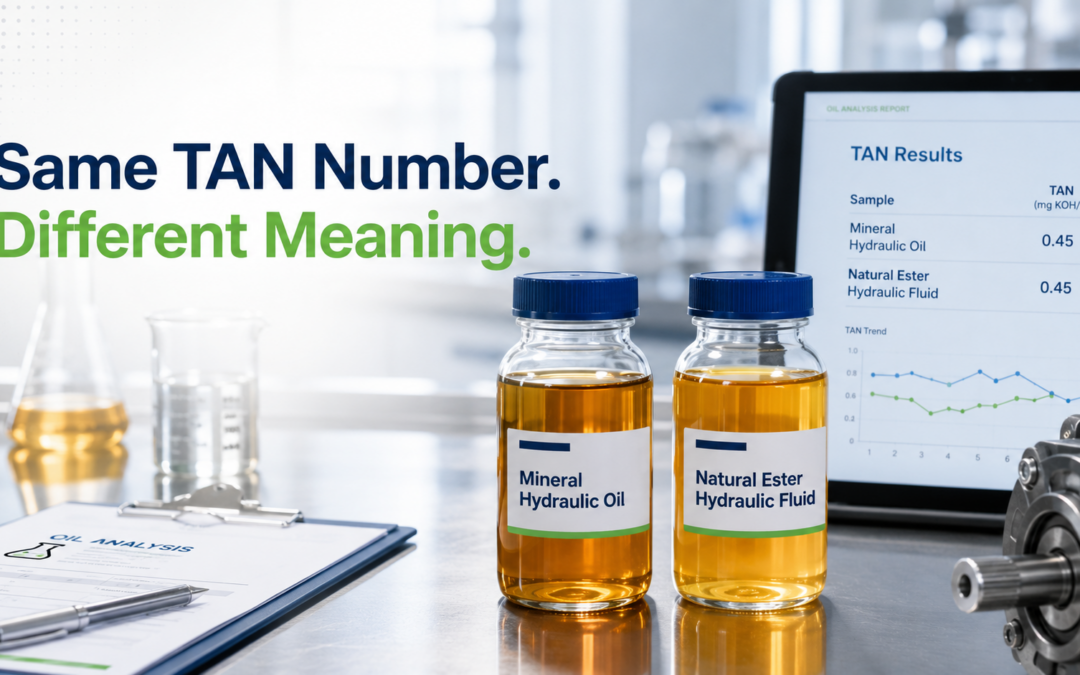
Total Acid Number (TAN) is often treated as a simple or automatic “change the oil” trigger—but that shortcut can lead to bad decisions when you compare mineral hydraulic oils to natural/ester-based fluids. Mineral oils typically start with very low TAN and are commonly condemned near ~2.0 mg KOH/g, while esters begin higher and can operate safely at two-to-four times that level when corrosion protection and viscosity remain in control.
This overview explains why absolute TAN isn’t the headline metric: what matters is the rise from new oil, the type/strength of acids being generated, and whether the additive system is still protecting metal surfaces. It also outlines practical monitoring ranges and decision checks—especially rust/copper corrosion performance, deposit formation, viscosity drift, and water control—so you can interpret high TAN correctly in ester fluids instead of applying mineral-oil limits by default.
The Basics:
- Mineral hydraulic oils start with a very low TAN and are usually condemned around 2.0 mg KOH/g.
- Natural/ester-based hydraulic oils start with a higher TAN and can typically run safely at TAN values two-to-four times higher than mineral oils, provided corrosion tests are still passing and viscosity hasn’t run away.
The key isn’t the absolute TAN; it’s how much it has risen vs. new oil, what kind of acids they are, and whether the additive package is still protecting metal.
1. How TAN Compares: Mineral vs Natural/Ester Hydraulic Oils
TAN (Total Acid Number) is mg of KOH needed to neutralize acids in 1 g of oil, typically measured by ASTM D664.
Typical new-oil TAN
Petroleum-based hydraulic oils (HLP / “regular” mineral oil):
- New-oil TAN is usually ~0.05–0.3 mg KOH/g.
- A Quaker Houghton skill-builder gives a representative value of 0.2 mg KOH/g for a mineral hydraulic fluid.
Natural / ester-based hydraulic fluids (I’ll lump together natural triglyceride HETG and ester-based HFDU/HEES-type fluids, since they behave similarly from a TAN standpoint):
- The base oil has residual fatty acids plus sometimes mildly acidic additives, so the starting TAN is higher, often 0.3–2.0 mg KOH/g depending on formulation.
- The Quaker Houghton data sheet shows ester-based hydraulic fluids with initial TANs of 0.4, 1.1 and 2.0 mg KOH/g, all higher than the 0.2 mg KOH/g mineral reference.
So if you compare a used mineral oil at TAN 1.2 to a fresh natural ester at TAN 1.2, the absolute numbers are the same, but the meaning is not. For the mineral oil, that’s a big increase from ~0.1. For the ester, that might just be its “born that way” TAN.
2. How TAN Relates to Corrosion Protection
Important nuance: TAN is an indirect indicator of oxidation/ageing and potential corrosiveness, but it does not directly measure corrosion risk. Several reasons:
- Strength and type of acids
- Mineral oil oxidation tends to generate short-chain, stronger organic acids (and associated sludge/varnish) that can attack steel and yellow metals; TAN rises as these accumulate.
- Natural and synthetic esters often have weak residual fatty acids built in from day one. These count toward TAN but are far less aggressive toward metal.
- Polarity and solubility of by-products
- Ester-based fluids are more polar, so oxidation products, soot and varnish dissolve better in the fluid rather than dropping out onto surfaces. That allows them to tolerate higher TAN values before you see deposits and sticking valves.
- Mineral oils are less polar; similar oxidation by-products tend to drop out earlier as sludge/varnish, causing sticky valves and fouling even at comparatively lower TAN.
- Additive system (inhibitors)
- Rust and yellow-metal protection comes from inhibitors (e.g., amine phosphate, sulfonate, etc.), not from having a TAN of “0.10 vs 0.30”.
- Your BioLube LV notes show a dedicated corrosion inhibitor (K-CORR 200-L) at a very low treat rate and nitrogen blanketing of the finished product, clear evidence that corrosion control is being engineered chemically, not by chasing ultra-low TAN.
So, for corrosion:
- Rising TAN in a mineral oil is a pretty direct red flag for more aggressive acids → more corrosion risk.
- Rising TAN in an ester needs to be interpreted more carefully:
- Some of the TAN is weak, built-in acidity.
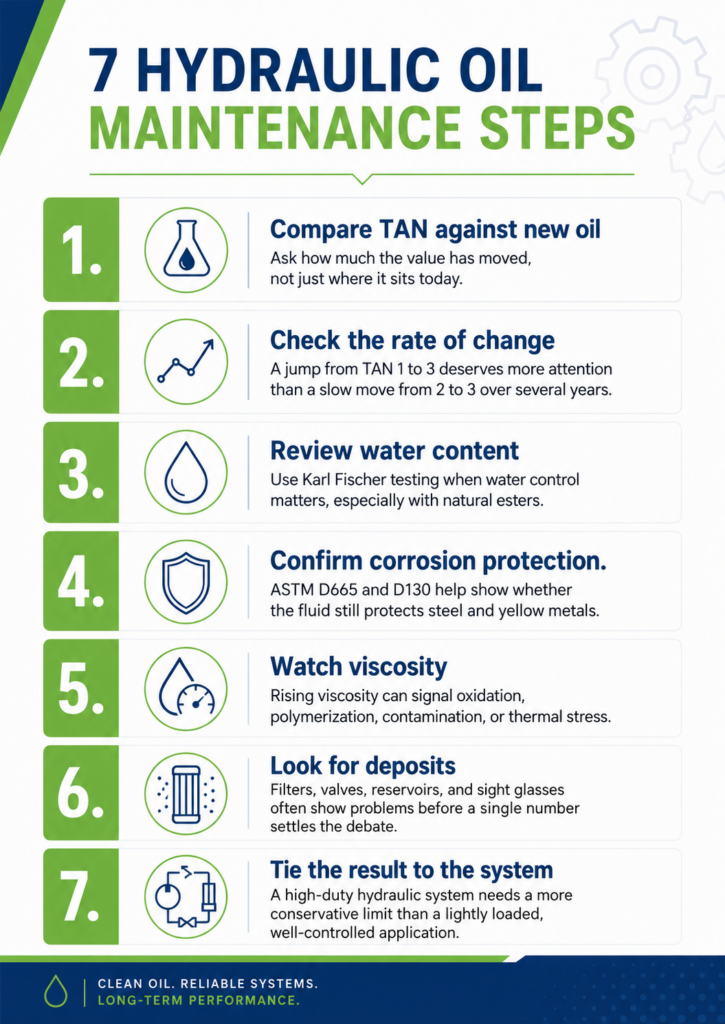
You must cross-check with ASTM D665 (rust), D130 (copper strip) and visual inspection for sludge/varnish to see if the acids that are forming are actually corrosive.
Condemning Limits: How High Can TAN Go?
These are typical industry practices, not hard standards. OEMs, the specific fluid supplier, and your oil lab will always have the final say.
3.1 Petroleum Several Industry Sources:
- Quaker Houghton explicitly recommends refreshing mineral-oil-based hydraulic fluids at TAN ≈ 2.0 mg KOH/g, with a fresh value ~0.2.
- A common “rule of thumb” (TestOil) is to condemn non-engine oils when TAN has doubled versus new oil (for many mineral hydraulic oils that ends up around 1–2 mg KOH/g).
- Fluid power articles often flag hydraulic oils as “of concern” once TAN gets ≥1.0 mg KOH/g, depending on the fluid type and system criticality.
Practical envelope for typical mineral hydraulic oil:
- New oil: ~0.05–0.3 mg KOH/g
- Watch / increased monitoring: TAN ≳ 1.0–1.5 mg KOH/g
- Typical condemn / change-out: around 2.0 mg KOH/g, or +1.0–2.0 mg above the new-oil TAN
Beyond ~2, the combination of more corrosive acids, additive depletion and sludge/varnish risk makes keeping the oil in service risky for most hydraulic systems.
3.2 Natural Esters and Ester-Based Hydraulic Fluids
Here we have two overlapping realities:
- Biodegradable / eco hydraulic fluids (HETG/HEES/HFDU) used in hydraulics.
- Natural esters used as transformer dielectrics, which have much stricter TAN limits due to electrical insulation requirements (often TAN limit ~0.1–0.2 mg KOH/g; that’s a different world, so I’ll keep the focus on hydraulics).
For ester-based hydraulic fluids, Quaker Houghton provides a nice comparative table:
| Fluid type | Initial TAN (mg KOH/g) | Recommended max TAN (mg KOH/g) |
|---|---|---|
| Mineral hydraulic oil | 0.2 | 2.0 |
| Ester-based HFD-U, competitor #1 | 0.4 | 4.0 |
| Ester-based HFD-U, competitor #2 | 1.1 | 5.0 |
| Ester-based HFD-U (QUINTOLUBRIC) | 2.0 | 8.0 |
Key takeaways:
- Ester fluids start higher et run safely to higher TAN than mineral oils.
- In Quaker’s pump tests, their ester fluid showed no visible wear, soot or varnish even at TAN ≈ 8, thanks to the base oil polarity and additive package.
For natural triglyceride hydraulic fluids (HETG):
- They behave like esters in terms of higher starting TAN and ability to “tolerate” higher TAN, but
- Their oxidation stability is poorer than saturated synthetic esters, so in practice most suppliers are more conservative.
Practical envelope for natural/ester hydraulic fluids:
These are broad, but reasonable working numbers if the OEM or supplier hasn’t given explicit limits:
- New oil TAN: typically 0.3–2.0 mg KOH/g
- Watch / increased monitoring:
- Once TAN has climbed by ~1.0–2.0 mg KOH/g above new-oil,
- or absolute TAN is in the 3–4 mg KOH/g range.
- Typical condemn / strong recommendation to change or recondition:
- For many natural triglyceride (HETG) hydraulics: ~4–5 mg KOH/g is a sensible “don’t cross” line, especially at higher operating temps.
- For high-performance synthetic esters (HEES/HFDU), some suppliers allow up to 6–8 mg KOH/g (as in the QUINTOLUBRIC example), provided corrosion, viscosity and cleanliness are still in spec.
In all cases, trend is king: a sudden jump from TAN 1 → 3 is more alarming than a slow drift from 2 → 3 over several years.
4. How to Connect This Back to Corrosion Decisions
When you’re deciding “is this oil still safe, or is TAN condemning?”, look at:
- ΔTAN vs. new oil
- Mineral: think “new + about 1–2 mg KOH/g” as your action band.
- Natural/esters: “new + about 2–3 mg KOH/g” is often acceptable, with a hard stop in the 4–5+ range unless the supplier says otherwise.
- Corrosion and deposit tests
- Rust test (ASTM D665), copper strip (D130), filterability and visual inspection for sludge/varnish.
- If TAN is high but you still pass rust/copper tests and the system is clean, the acids are likely weak and mostly solvated.
- Viscosity and water
- Particularly for natural esters, water plus heat = hydrolysis, which can spike TAN and generate more corrosive species; tight water control is crucial.
- Your specific formulation
- In your BioLube case, you’ve got:
- A dedicated corrosion inhibitor (K-CORR 200-L) at extremely low treat rate, and
- Nitrogen treatment of the finished product to slow oxidative TAN increase.
- In your BioLube case, you’ve got:
That’s exactly the pattern for an ester fluid intended to operate safely at a higher TAN window than a mineral oil, while keeping corrosion fully controlled.
Contact us to learn more about the benefits of using to biodegradable lubricants, or browse our full product offerings.
Total Acid Number FAQs
What is Total Acid Number in hydraulic oil?
Total Acid Number, or TAN, measures the amount of potassium hydroxide required to neutralize acidic components in one gram of oil. It is commonly reported in mg KOH/g and measured by ASTM D664.
What is a normal TAN for mineral hydraulic oil?
New mineral hydraulic oils commonly start around 0.05–0.3 mg KOH/g. Many systems move into a watch range around 1.0–1.5 mg KOH/g, depending on the fluid, system, and lab guidance.
What TAN level means hydraulic oil should be changed?
For many mineral hydraulic oils, TAN near 2.0 mg KOH/g is commonly treated as a change-out point. You should also review viscosity, water, corrosion tests, filter condition, and OEM guidance before making the final decision.
Why do natural ester hydraulic fluids have higher TAN?
Natural ester and ester-based hydraulic fluids often contain residual fatty acids, polar ester chemistry, and additive components that contribute to a higher starting TAN. That higher baseline does not automatically mean the oil is degraded.
Can ester hydraulic fluids operate safely at higher TAN?
Yes. Many ester-based hydraulic fluids can operate safely at higher TAN values than mineral oil when corrosion protection, viscosity, cleanliness, and water content remain within acceptable limits.
Does a high TAN always mean corrosion is happening?
No. TAN indicates acidic components, but it does not directly measure corrosion. Use rust testing, copper strip corrosion, water content, viscosity, and system inspection to understand the actual risk.
Why is water control important in natural ester fluids?
Water and heat can accelerate hydrolysis in ester fluids. Hydrolysis can increase TAN and create more aggressive acidic species, so moisture control has a direct impact on fluid life.
Should I use the same TAN limit for mineral oil and natural ester hydraulic fluid?
No. Mineral oils and ester-based hydraulic fluids start with different TAN values and age differently. Always compare used oil against the specific fluid’s new-oil baseline and supplier guidance.
 FR
FR  EN
EN