
Wire rope is designed to handle heavy loads, repeated movement, and demanding operating conditions. But even a high-quality rope is the sum of its parts: a system of individual wires and strands that move against one another. That movement makes wire rope lubrication more than a routine maintenance task.
The right wire rope lubricant helps control internal friction while protecting exposed surfaces from moisture, corrosion, abrasion, and other conditions that can contribute to premature wear. Those functions become especially important for cranes and pile-driving equipment operating in marine construction environments.
For contractors working around docks, bridges, waterways, and other sensitive environments, lubricant selection may introduce another consideration as well: what happens if when some of that lubricant enters the surrounding environment? Understanding how wire rope lubrication works and what to look for in a lubricant can help you develop a better approach to reliability, maintenance, and service life.
Why Is Wire Rope Lubrication Important?
Wire rope lubrication reduces friction between wires and strands while protecting the rope against corrosion, moisture, and external wear. Proper lubrication can support reliable operation and maximize wire rope service life, particularly in demanding applications such as cranes, pile driving, and marine construction.
To understand why, it helps to remember that a wire rope is not one solid piece of steel.
Reducing Internal Friction
When a wire rope bends around a sheave or wraps onto a drum, individual wires and strands shift as the rope changes shape. Under load, this repeated movement can create metal-on-metal friction within the rope.
A suitable wire rope lubricant helps create a lubricating film between these moving surfaces, reducing friction and helping protect against wear. This is why penetration matters. A rope that simply appears greasy on the outside is not necessarily receiving adequate lubrication where individual wires and strands interact.
Protecting the Exterior of the Rope
The exterior of the wire rope faces a different set of threats. Depending on the application, the rope may encounter:
- Water and persistent moisture
- Salt spray
- Dirt, grit and jobsite debris
- Abrasive contact
- Weather exposure
- Corrosive environments
A wire rope lubricant therefore needs to do more than reduce internal friction. It should also remain on the rope and provide a protective barrier against external operating conditions.
This combination of lubrication and protection is common across industrial equipment. For example, hydraulic fluids are also expected to reduce friction while helping protect components against wear and heat. The difference is that wire rope lubrication has to address the unusual combination of internal strand movement and an exposed exterior surface.
Why Marine Construction Is Especially Hard on Wire Rope
Wire rope is used across many industries, but marine construction equipment can expose ropes to several challenging conditions simultaneously.
Water, Moisture and Corrosion
Moisture is one of the most obvious concerns for wire rope used in marine environments. Water can affect external rope surfaces, but corrosion can also develop in less visible areas of the rope. That makes corrosion protection an important consideration when selecting lubricants for ropes that regularly encounter humidity, rain, splash, or other moisture.
For applications with frequent water exposure, a lubricant also needs sufficient resistance to water washout. This allows it to continue protecting the rope after application.
Abrasion and Contamination
Marine construction sites are rarely clean operating environments. Sand, dirt, and other particles can accumulate on equipment and come into contact with rope as it moves over drums and sheaves. Abrasive wear can occur both inside and outside wire ropes, including external wear involving contaminants accumulated during spooling.
This creates an important maintenance balance: the lubricant needs enough adhesion to remain on the rope, but maintenance teams should also avoid simply applying fresh lubricant over significant contamination.
Repeated Bending Cycles
Wire rope does not have to visibly fail for wear to be occurring. Every trip around a drum or sheave causes the rope to bend and its internal components to move. Equipment with frequent operating cycles may repeat this process thousands of times.
OSHA’s crane wire rope inspection requirements specifically call attention to locations including reverse bends, flange points, crossover points, and repetitive pickup points because these are areas where wire rope condition deserves particular attention. Lubrication cannot eliminate those forces, but reducing friction between moving surfaces is one part of managing the resulting wear.
Lubricant Wash-Off and Fling-Off
A lubricant that does not remain on the rope cannot continue doing its job. Water exposure can wash away inadequately suited lubricants, while rope movement and equipment speed can contribute to lubricant fling-off.
For this reason, adhesion and cohesion are particularly important properties when selecting a wire rope lubricant for marine applications.
How to Lubricate Wire Rope
The correct procedure will depend on the rope, equipment, and manufacturer’s instructions, but a sound wire rope maintenance program generally includes inspection, cleaning when necessary, lubricant selection, and controlled application.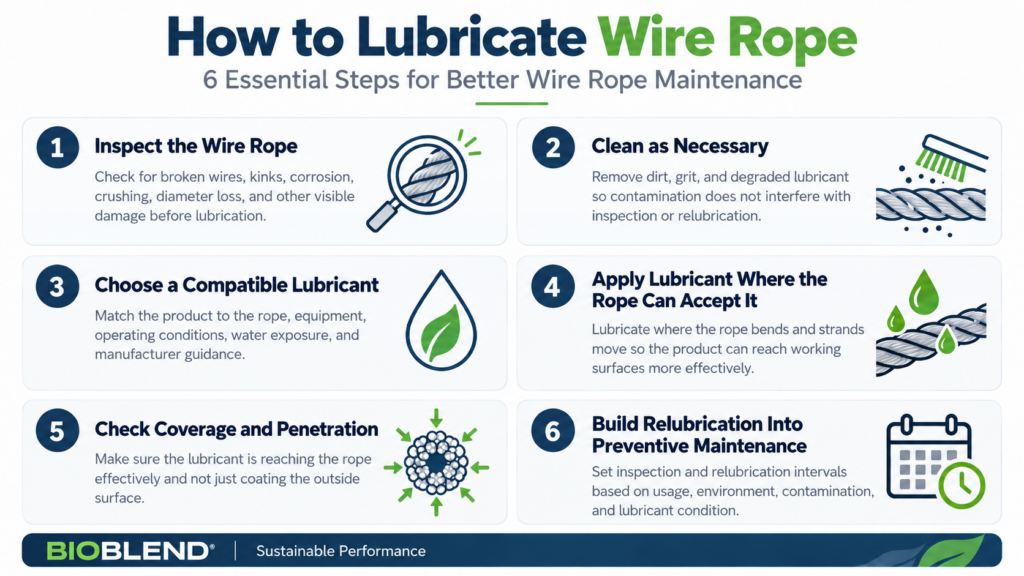
1. Inspect the Wire Rope
Before adding lubricant, inspect the condition of the rope. Potential warning signs can include:
- Broken wires
- Kinking
- Crushing
- Unstranding
- Corrosion
- Core problems
- Diameter reduction
- Damaged end connections
- Other visible deformation or wear
For cranes and derricks covered by OSHA construction requirements, wire ropes are subject to specific inspection criteria, including visual inspections and defined responses when deficiencies are identified.
Lubrication should never be used to disguise damage or postpone the removal of a rope that no longer meets applicable safety requirements. OSHA also specifies that lubricants that hinder wire rope inspection must not be used.
2. Clean the Rope as Necessary
Applying new lubricant directly over heavy dirt, grit, or degraded lubricant may trap abrasive contamination rather than solving the underlying maintenance problem. The rope should be cleaned as appropriate for the equipment, rope construction, and manufacturer’s recommendations before relubrication.
The objective is not necessarily to strip every trace of lubricant from the rope. It is to remove contamination that could interfere with inspection or prevent the new lubricant from reaching and protecting the rope effectively.
3. Choose a Compatible Wire Rope Lubricant
Before changing products, evaluate:
- Rope manufacturer recommendations
- Equipment manufacturer requirements
- Existing lubricant compatibility
- Operating temperature
- Load and duty cycle
- Water exposure
- Contamination
- Application method
- Environmental requirements
Selection of replacement wire rope itself is required by OSHA to follow recommendations from the rope manufacturer, equipment manufacturer, or a qualified person, underscoring the importance of manufacturer guidance in crane wire rope management generally.
A lubrication specialist can also help determine whether a particular grease or lubricant is appropriate for the application.
4. Apply Lubricant Where the Rope Can Accept It
Lubricant application is often particularly useful where rope strands are moving as the rope bends.
The appropriate application method will depend on the equipment and lubricant. The key is achieving useful coverage and penetration rather than simply creating a thick coating on the outer surface.
5. Check Coverage and Penetration
After application, evaluate whether the lubricant is reaching the rope effectively and remaining in place during operation.
A shiny or heavily coated exterior does not automatically indicate effective internal lubrication.
6. Build Relubrication Into Preventive Maintenance
There is no universal schedule for how often every wire rope should be lubricated.
Relubrication frequency can depend on:
- Equipment usage
- Duty cycles
- Load
- Rope speed
- Water exposure
- Temperature
- Contamination
- Lubricant condition
- Manufacturer recommendations
Maintenance teams should combine lubrication with regular wire rope inspection rather than treating them as separate processes.
Common Wire Rope Lubrication Mistakes
Good lubricant can only do so much if the maintenance approach around it is ineffective.
- Only Lubricating the Surface: One of the most common misconceptions is that a visibly coated rope is necessarily a properly lubricated rope. Because wear also occurs between internal wires and strands, penetration is an important consideration.
- Waiting Until the Rope Looks Dry: The appearance of the outer surface provides only limited information about lubricant condition throughout the rope. Inspection and maintenance practices should account for equipment use and service conditions rather than waiting until a rope appears completely dry.
- Lubricating Over Heavy Contamination: Dirt and abrasive particles should not simply be buried under another layer of grease. Where significant contamination is present, proper cleaning and inspection should come before relubrication.
- Using the Wrong Type of Grease: Not every grease is a wire rope grease. Products designed for unrelated applications may not provide the combination of penetration, lubricity, adhesion, corrosion protection, and water resistance required by the rope’s operating environment.
- Treating Lubrication as a Substitute for Inspection: Perhaps most importantly, lubrication does not repair a damaged wire rope. Broken wires, significant corrosion, or deformation need to be evaluated according to the applicable manufacturer requirements, equipment procedures, and safety standards.
Crane Wire Rope Lubrication
Cranes place unique demands on wire rope because the rope repeatedly interacts with drums, sheaves, and other components while carrying changing loads.
The rope may experience:
- Repeated bending
- Drum crossover points
- High-load cycles
- Environmental exposure
- Contact with contaminants
- Changes in rope tension during operation
OSHA specifically identifies several of these locations as critical review areas during construction crane wire rope inspections.
For that reason, crane wire rope lubrication should be considered part of a larger preventive maintenance and inspection program. Lubricant selection should reflect the crane manufacturer’s requirements, rope construction, operating environment, and duty cycle.
Wire Rope Lubrication for Pile Driving Equipment
Pile driving combines several of the challenges discussed above. Equipment may be exposed to water and weather while simultaneously operating under heavy loads, vibration, and repetitive cycles. Dirt, mud, sand, and other abrasive material may be present around the work area as well.
That means a pile-driving contractor may need to account for:
- Cyclic loading
- Frequent rope movement
- Abrasive contamination
- Water exposure
- Corrosion
- Outdoor equipment storage
- Lubricant washout
- Lubricant fling-off
These conditions make wire rope lubricant selection more nuanced than simply choosing a general-purpose grease.
They also make pile driving a strong example of why lubrication should be viewed as part of equipment reliability. The objective is not simply to “grease the cable,” but to select and maintain a lubricant capable of protecting a multi-component rope throughout demanding operation.
For contractors operating on docks, seawalls, bridges, and other waterfront projects, this maintenance strategy can fit within a broader approach to selecting lubricants for marine equipment that provide required equipment performance while addressing the risks associated with lubricant use around water.
Why Consider Biodegradable Wire Rope Lubricants for Marine Applications?
Any equipment operating around water can release lubricant into the surrounding environment through leakage, wash-off, maintenance activities, or other releases.
This makes lubricant selection particularly important for:
- Marine construction
- Dock and pier work
- Bridge construction
- Waterfront pile driving
- Barges and work vessels
- Hoists and winches
- Cranes operating near waterways
A biodegradable wire rope lubricant can offer an alternative for companies seeking to reduce the environmental impact of lubricant loss. But environmental performance should not come at the expense of equipment protection.
A wire rope grease still needs to provide the characteristics required by the application, including suitable lubricity, penetration, adhesion, corrosion resistance, and protection against water washout.
That’s a principle behind BioBlend’s broader line of biodegradable industrial lubricants: environmental objectives and industrial performance should be considered together rather than treated as competing priorities.
BioGrease WRG for Wire Rope and Cable Applications
For applications requiring a grease specifically formulated for wire ropes and cables, BioGrease WRG is a readily biodegradable aluminum complex wire rope grease available in NLGI 0, 1 and 2 grades.
BioGrease WRG is formulated to protect and potentially extend the service life of wire ropes and cables in operation. It uses natural ester base oils and an aluminum complex thickener designed to provide protection against water washout in high-moisture environments.
Its extra-tacky characteristics increase adhesion to wire ropes and cables while improving cohesion to help reduce fling-off. The formulation also includes rust and corrosion inhibitors for equipment exposed to frequent or continuous moisture.
Those properties make BioGrease WRG particularly relevant for marine environments and other applications where water exposure is a regular concern.
BioBlend also classifies BioGrease WRG as an environmentally acceptable lubricant under the EPA’s 2013 Vessel General Permit criteria.
For operations evaluating other lubrication needs alongside wire rope maintenance, BioBlend’s marine industry solutions include biodegradable greases, multipurpose oils, and other lubricant options designed for equipment operating in high-moisture environments.
Need help determining whether BioGrease WRG fits your crane, pile-driving equipment, or other wire rope application? Contact BioBlend to discuss the equipment, operating environment, and lubrication requirements with our team.
Frequently Asked Questions About Wire Rope Lubrication
What Is the Best Lubricant for Wire Rope?
The best lubricant for wire rope is typically a dedicated wire rope or cable lubricant that can penetrate and lubricate the strands while providing adequate adhesion and protection against wear, moisture, rust, and corrosion. The correct product depends on rope construction, equipment requirements, and the operating environment.
For high-moisture and marine applications, water resistance and corrosion protection become particularly important.
How Often Should Wire Rope Be Lubricated?
There is no universal relubrication interval for all wire ropes. Frequency depends on equipment usage, operating environment, loads, bending cycles, contamination, water exposure, lubricant condition, and manufacturer recommendations.
Regular inspection should be used to help determine when relubrication is appropriate.
How Do You Lubricate Wire Rope?
Start by inspecting the rope for damage and contamination. Clean the rope as appropriate, verify lubricant compatibility, and apply a wire rope lubricant in a manner that promotes coverage and penetration between wires and strands. Follow the wire rope and equipment manufacturer’s recommendations for application and maintenance.
Can You Use Regular Grease on Wire Rope?
A general-purpose grease is not automatically suitable for wire rope.
Wire ropes can require a combination of penetration, lubricity, adhesion, water resistance, and corrosion protection. Equipment owners should use a lubricant appropriate for the rope, application, and manufacturer’s requirements rather than assuming any grease will provide adequate protection.
Can WD-40 Be Used as a Cable Lubricant?
WD-40 may provide temporary light lubrication and water displacement, but it is generally not a replacement for a dedicated wire rope lubricant in industrial, high-load, or long-term applications.
Industrial wire ropes require a lubricant capable of remaining in place, reducing wear and providing ongoing protection against moisture and corrosion. A product specifically designed as a wire rope grease is generally better suited to these applications.
 FR
 EN