
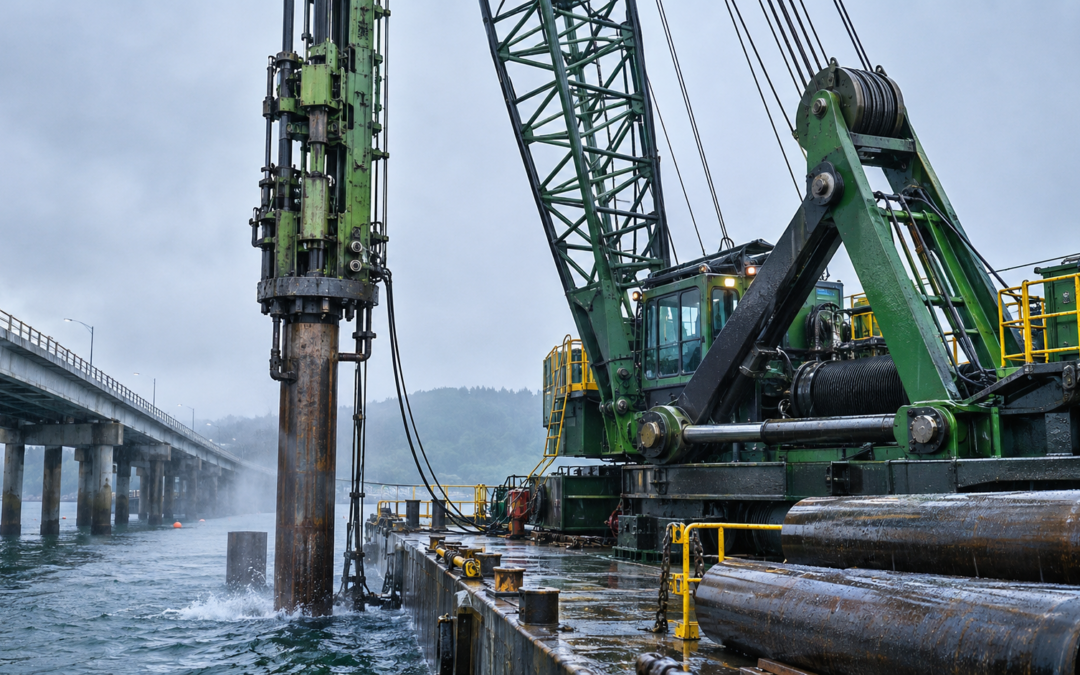
Pile driving equipment operates in conditions that can be particularly demanding on grease. Heavy loads, shock, vibration, water, salt, dirt, and abrasive contaminants can all challenge the lubricant protecting critical components.
The right grease needs to do more than reduce friction. On pile driving equipment, it needs to remain where it is applied, protect components under load, resist water washout and contamination, and continue providing lubrication in demanding outdoor conditions, all while maintaining and/or improving uptime.
For equipment working on barges, bridges, ports, shorelines, and other marine construction projects, environmental exposure adds another consideration. Grease used on exposed components can eventually leave the equipment, making biodegradable grease worth evaluating alongside conventional performance requirements.
Why Is Grease Important on Pile Driving Equipment?
Grease provides lubrication in applications where a fluid lubricant may not remain in place or where components require a more persistent lubricating film.
On pile driving and related heavy construction equipment, grease may be used on:
- Pins and bushings
- Bearings
- Sliding surfaces
- Exposed joints
- Sheaves
- Pivot points
- Other high-load or slow-moving components
These lubrication points can be subjected to heavy loads while simultaneously being exposed to moisture, dirt, and other contaminants.
Failure to maintain an appropriate lubricating film can increase metal-to-metal contact and wear. Contamination or lubricant loss can further reduce protection.
For maintenance teams, grease selection therefore isn’t simply about finding a product that can be pumped through a grease gun. The grease has to remain effective after it reaches working application.
What Should You Look for in Grease for Pile Driving Equipment?
There is no single grease that is appropriate for every component or every piling rig. Equipment manufacturer recommendations should always be considered when selecting a lubricant.
However, several performance characteristics are especially important when equipment operates under heavy loads and in wet, dirty environments.
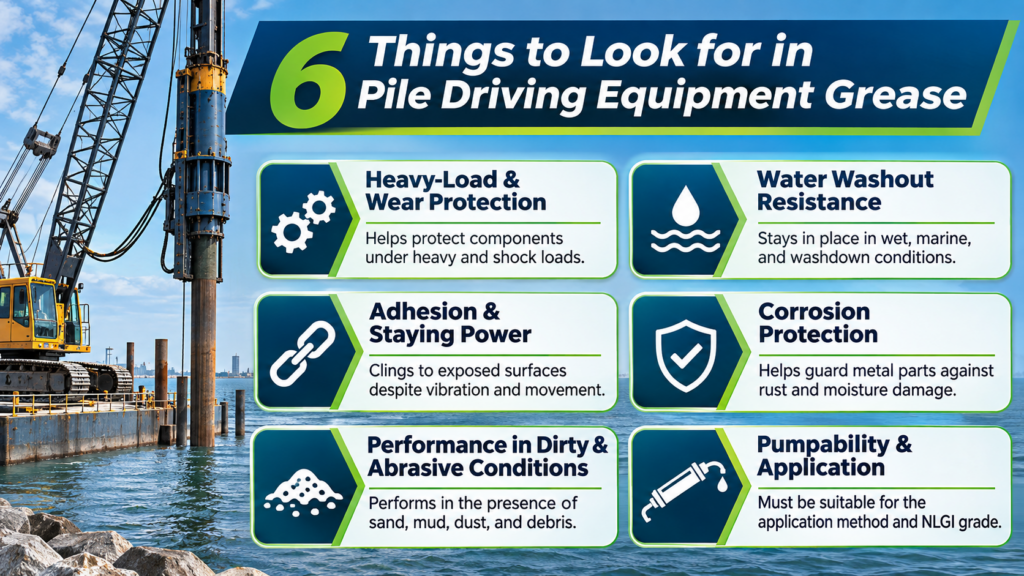
1. Heavy-Load and Wear Protection
Pile driving equipment is designed to handle substantial forces, and many lubricated components operate under heavy or shock loads. Grease needs to maintain a protective lubricating film between contacting surfaces. Extreme-pressure and antiwear performance can be particularly important for components subjected to high loads.
Pins and bushings are a good example. These components may experience repeated movement under load, making effective lubrication important for controlling friction and wear.
The objective is straightforward: keep the load-bearing surfaces separated and protected for as long as possible between lubrication intervals.
2. Water Washout Resistance
Water is an unavoidable part of many marine construction environments. Rain, spray, waves, washdowns, and direct exposure can all challenge grease on exposed components. If the lubricant washes away easily, the component can lose its protective film and become more vulnerable to wear and corrosion.
This makes water resistance an important consideration when choosing grease for pile driving equipment used around:
- Barges
- Piers and docks
- Bridges
- Shorelines
- Wetlands
- Ports
- Other marine or waterfront construction sites
A grease formulated for these conditions will be capable of staying on the component despite exposure to water.
3. Adhesion and Staying Power
A grease cannot protect a component if it doesn’t remain where it was applied. Pile driving rigs experience vibration, movement, and repetitive operating cycles that can challenge lubricant retention. Exposed lubrication points can also be affected by weather and water.
A grease with appropriate adhesion can help the lubricant remain on the lubricated surface instead of being displaced prematurely. For maintenance crews, good staying power may also contribute to more predictable lubrication practices by helping the grease remain effective between scheduled applications.
4. Protection Against Corrosion
Moisture exposure can contribute to rust and corrosion on metal components. That makes corrosion protection particularly relevant for piling rigs operating in marine, coastal, and other wet environments.
Grease serves as both a lubricant and a protective barrier on many exposed surfaces. Selecting a product designed for wet conditions will help protect metal components while the equipment is operating and between uses.
5. Performance in Dirty and Abrasive Conditions
Water isn’t the only environmental challenge. Pile driving equipment can encounter soil, sand, dust, mud, and other contaminants. When abrasive particles enter a lubricated interface, they can accelerate component wear.
Proper grease selection should therefore be accompanied by good lubrication practices. Before applying fresh grease, maintenance teams should inspect lubrication points for excessive contamination and follow equipment manufacturer recommendations for cleaning, application quantity, and lubrication intervals.
Adding more grease isn’t always the same as improving lubrication. Get the RIGHT Grease, in the RIGHT Place, at the RIGHT Time, and in the RIGHT Amount.
6. Pumpability and Application
Performance on the component matters, but the grease also has to be practical to apply. Temperature, grease consistency, equipment design, and centralized lubrication systems can all influence grease selection.
A product that performs well after application but cannot be reliably delivered to the lubrication point is not the right choice for the system. Maintenance teams should consider the recommended NLGI grade and application method in addition to load, water, and environmental requirements.
Why Does Grease Selection Matter More Around Water?
Unlike lubricant contained inside a closed system, grease is frequently applied to components that are partially or completely exposed. That means some grease can eventually leave the lubrication point through normal operation, water exposure, maintenance, or over-application.
For equipment operating on land, that can create housekeeping and environmental concerns. For pile driving equipment operating over or adjacent to water, there is an additional potential pathway into the surrounding environment.
This makes exposed grease applications a logical part of a contractor’s environmental lubricant review. However, the answer isn’t simply to select any product labeled “biodegradable.” The grease still has to protect the equipment.
A biodegradable grease for pile driving applications should be evaluated for the same performance characteristics as a conventional product, including load protection, water resistance, adhesion, corrosion protection, consistency, and application requirements.
Can Biodegradable Grease Handle Heavy-Duty Equipment?
Biodegradability and heavy-duty performance are not mutually exclusive. A biodegradable grease can be formulated with biodegradable base oils, appropriate thickeners, and performance additives designed for demanding equipment applications.
The important point for contractors and maintenance managers is to evaluate the complete lubricant, rather than assuming its environmental characteristics determine its technical performance.
When considering biodegradable grease, ask:
- Is it suitable for the equipment and component?
- Does it provide the required load and wear protection?
- How well does it resist water?
- Will it remain on exposed surfaces?
- Is the NLGI grade appropriate?
- Is it compatible with the grease currently in use?
- Does it meet applicable OEM or project requirements?
- What environmental characteristics does the product provide?
The goal is not to choose between equipment protection and environmental responsibility. It is to find a lubricant that appropriately addresses both.
BioBlend Grease Options for Pile Driving Equipment
BioBlend offers multiple biodegradable grease products for pile driving and heavy-equipment applications, including BioGrease HD, BioGrease HDS XT, BioGrease ALC XT, BioGrease HD 1, and BioGrease WRG.
For example, BioGrease HD 2 is a biodegradable heavy-duty lithium grease formulated with biodegradable base oils, lithium thickener, and extreme-pressure additives.
Different grease formulations and consistency grades are intended for different applications, so contractors should not select a product based on biodegradability alone.
The equipment, lubrication point, operating conditions, application method, and OEM requirements should determine which grease is appropriate. BioBlend can help evaluate these requirements and identify biodegradable grease options for specific pile driving and marine construction applications.
Build Grease Into the Entire Pile Driving Lubrication Program
Grease can be easy to overlook because piling rigs contain other systems with much larger lubricant volumes.
But volume isn’t the only measure of lubrication importance.
A relatively small amount of grease may be responsible for protecting a heavily loaded pin, bushing, bearing, or joint that is critical to equipment operation.
That’s why a comprehensive lubrication review should consider the entire machine:
- Fluides hydrauliques for hydraulic pumps, motors, valves and actuators
- Graisses for pins, bushings, bearings and exposed joints
- Huiles pour engrenages for gearboxes and other enclosed gearing
- Wire rope lubricants for cranes, hoists and pile driving systems
- Other specialty lubricants required by the equipment
For contractors working around water, each lubricant can then be evaluated from two perspectives:
- What does the equipment require from this lubricant?
- What are the consequences if this lubricant enters the surrounding environment?
Choosing the Right Grease for Your Pile Driving Equipment
Before changing grease, review the equipment manufacturer’s requirements and the conditions at each lubrication point. Important considerations include: required NLGI grade, water exposure, operating temperature, application method, etc.
For marine construction applications, biodegradable characteristics can be another important part of that evaluation.
The goal remains the same: protect critical equipment, support reliable operation, and choose a lubricant appropriate for the environment where the equipment works.
BioBlend can help contractors identify biodegradable grease options for pile driving, marine construction, and other heavy-duty equipment operating in wet or environmentally sensitive areas.
Frequently Asked Questions About Grease for Pile Driving Equipment
Why is water washout resistance important for heavy-equipment grease?
Water can remove grease from exposed lubrication points, reducing the protective lubricant film and leaving components more vulnerable to wear and corrosion. Water washout resistance is therefore particularly important for pile driving and marine construction equipment exposed to rain, spray, washdowns, or surrounding water.
Can different types of grease be mixed?
Greases can use different base oils, thickeners, and additive systems, and not all formulations are compatible. Mixing incompatible greases can affect consistency and performance. Check equipment requirements and lubricant compatibility before changing grease products.
Why use biodegradable grease on pile driving equipment?
Pile driving equipment often operates around water and environmentally sensitive areas, while many grease points are exposed to the surrounding environment. An appropriate biodegradable grease can provide the required equipment protection while reducing environmental persistence if lubricant leaves the application.
 FR
 EN