
Pile driving equipment puts hydraulic systems through demanding operating conditions. High pressures, repetitive duty cycles, heavy loads, and outdoor operating environments all make hydraulic fluid selection an important part of equipment reliability.
For pile driving contractors working on marine, bridge, port, wetland, and other infrastructure projects, there is another consideration: where that hydraulic fluid could go if a hose, fitting, or seal fails.
A hydraulic leak on land can create cleanup and maintenance problems. A leak from equipment operating on a barge, shoreline, or near environmentally sensitive areas can create additional concerns because hydraulic fluid may reach surrounding soil or water.
That makes hydraulic fluid one of the first places contractors should consider when evaluating their lubrication program. The objective, however, isn’t simply to choose a “greener” fluid. The hydraulic fluid still has to protect the equipment and perform under the conditions the piling rig experiences.
Why Is Hydraulic Fluid So Important on Pile Driving Equipment?
Hydraulic systems power critical functions throughout heavy equipment. Fluide hydraulique serves as the medium that transmits power while simultaneously lubricating components, helping seal clearances, carrying heat, and transporting contaminants toward filtration.
That means the hydraulic fluid isn’t merely another maintenance consumable. Its condition and performance can directly affect the operation and longevity of pumps, motors, valves, actuators, and other hydraulic components.
This is particularly important in pile driving because equipment downtime can have consequences beyond the machine itself. A stalled rig can potentially disrupt crews, cranes, barges, material schedules, and other activities that depend on the pile-driving operation.
Selecting hydraulic fluid therefore needs to balance several priorities:
- Equipment protection
- Hydraulic system performance
- Operating temperature
- Component and seal compatibility
- Fluid service life
- Environmental exposure
- Project requirements
For marine construction, that last consideration can become especially important.
Why Are Hydraulic Leaks a Concern During Pile Driving?
Pile driving equipment frequently operates in locations where hydraulic leaks can be difficult to contain.
Depending on the project, equipment may be operating on or around:
- Barges
- Docks and piers
- Bridges
- Shorelines
- Wetlands
- Temporary construction mats
- Ports and marine terminals
- Other areas adjacent to water
A hydraulic hose failure, damaged fitting, worn seal, or other leak can release fluid onto equipment, decks, soil, or surrounding water.
Hydraulic systems can also contain substantially more lubricant than individual grease points or many other lubricated components. As a result, evaluating hydraulic fluid can be a practical starting point when contractors want to reduce the environmental consequences associated with lubricant releases.
That does not mean biodegradability should replace equipment performance as the primary selection criterion.
The better question is:
Can we use a hydraulic fluid that provides the equipment protection the application requires while also reducing environmental impact if a release occurs?
Modern biodegradable hydraulic fluids can make that combination possible.
What Should You Look for in Hydraulic Fluid for a Piling Rig?
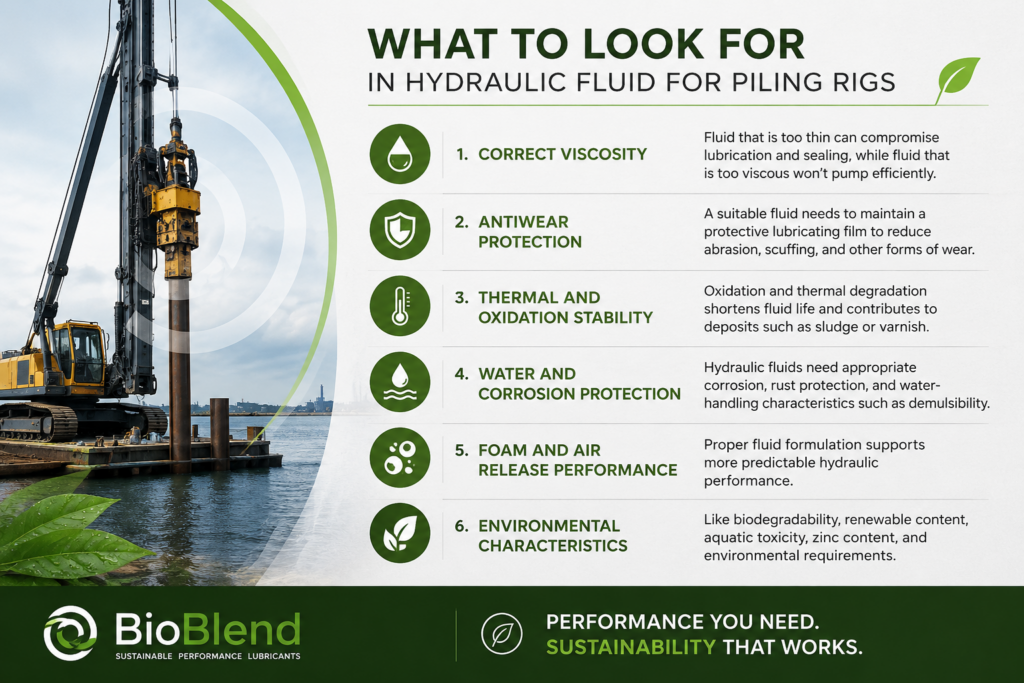
There isn’t one hydraulic fluid that’s right for every piling rig. Equipment manufacturers’ specifications should remain the starting point when choosing a fluid.
From there, contractors and maintenance teams should consider the equipment, operating environment, and demands placed on the hydraulic system.
1. Correct Viscosity
Viscosité measures a fluid’s resistance to flow and has a major effect on hydraulic system performance.
Fluid that is too thin can compromise lubrication and sealing, while fluid that is too viscous can become difficult to pump efficiently. Either condition can negatively affect equipment performance and contribute to wear.
The appropriate viscosity should account for the equipment manufacturer’s requirements and expected operating temperatures.
2. Antiwear Protection
Pumps, motors, valves, and other hydraulic components contain moving surfaces that require lubrication.
A suitable hydraulic fluid needs to maintain a protective lubricating film and provide appropriate antiwear performance to reduce abrasion, scuffing and other forms of wear.
For high-value pile driving equipment, this is one reason environmental attributes shouldn’t be considered independently from technical performance.
3. Thermal and Oxidation Stability
Hydraulic systems generate heat, and demanding duty cycles can place additional thermal stress on the fluid.
Oxidation and thermal degradation can shorten fluid life and contribute to deposits such as sludge or varnish. Choosing a fluid with appropriate thermal and oxidative stability can help it withstand demanding operating conditions.
4. Water and Corrosion Protection
Water exposure is an especially relevant concern for marine construction.
Water can enter hydraulic systems through contamination or condensation and contribute to corrosion. Hydraulic fluids therefore need appropriate corrosion and rust protection, while water-handling characteristics such as demulsibility may also be important depending on the fluid and application.
5. Foam and Air Release Performance
Entrained air and foam can interfere with hydraulic-system performance because air is compressible and provides poor lubrication compared with the hydraulic fluid itself.
Proper fluid formulation can help control foam and release entrained air, supporting more predictable hydraulic performance.
6. Environmental Characteristics
For pile driving equipment working around waterways or environmentally sensitive areas, contractors may also want to evaluate characteristics such as:
- Biodégradabilité
- Renewable content
- Aquatic toxicity
- Zinc content
- Applicable environmental requirements or project specifications
These characteristics should be considered alongside, rather than instead of, the technical requirements of the equipment.
Can Biodegradable Hydraulic Fluid Perform in Heavy-Duty Pile Driving Equipment?
Yes. A biodegradable hydraulic fluid can be formulated for demanding mobile and industrial hydraulic applications. The important distinction is that “biodegradable” describes an environmental characteristic; it does not by itself tell you whether a fluid is appropriate for a particular hydraulic system.
Contractors should still evaluate viscosity, antiwear performance, temperature range, oxidation stability, equipment compatibility, and other performance requirements. This is also why biodegradable hydraulic fluids shouldn’t automatically be equated with older vegetable-oil formulations or assumed to provide inferior equipment protection.
Modern formulations can use synthetic and renewable base stocks along with additive technology designed to provide both environmental and technical performance. For pile driving contractors, that’s the key point:
The goal isn’t to sacrifice equipment reliability for environmental performance. It’s to identify a fluid capable of delivering both.
Why Start a Biodegradable Lubricant Transition With Hydraulics?
A contractor doesn’t necessarily need to replace every lubricant across an equipment fleet at once. A more practical approach is to identify the systems with the greatest combination of:
fluid volume + leak potential + environmental exposure.
For many pile driving operations, hydraulic systems can rank highly across all three.
Starting there can allow a contractor to address a meaningful source of potential lubricant release while keeping the transition manageable. Once hydraulic systems have been evaluated, the same review can expand to other lubrication points on the piling rig, including:
- Greased pins and bushings
- Bearings and exposed joints
- Gearboxes
- Winches
- Wire ropes and cables
This creates a systematic approach to reducing lubricant exposure rather than making isolated product substitutions.
BioBlend Hydraulic Fluid Options for Pile Driving Equipment
BioBlend offers biodegradable hydraulic fluid options designed for mobile and industrial hydraulic systems, including BioFlo Synthétique AW et BioFlo SB AW.
BioFlo Synthétique AW
BioFlo Synthétique AW is a fully synthetic, readily biodegradable hydraulic fluid designed for performance in extreme temperatures and extended operating periods.
Its combination of environmental characteristics and hydraulic-system performance makes it an option worth evaluating for demanding applications where both equipment protection and environmental exposure are important considerations.
BioFlo SB AW
BioFlo SB AW is a synthetic-blend, readily biodegradable, zinc-free antiwear hydraulic oil formulated from renewable base stocks for mobile and industrial hydraulic systems.
For pile driving contractors, these products provide alternatives to conventional hydraulic oils when biodegradable characteristics are desirable or required.
The appropriate product and viscosity should always be selected according to the equipment, OEM recommendations, and operating environment.
Performance Still Comes First
Choosing biodegradable lubricants shouldn’t mean lowering the standard for equipment protection.
Pile driving rigs experience shock, vibration, heavy loads, demanding hydraulic cycles, and challenging outdoor conditions. Lubricant selection needs to reflect those realities.
A useful way to approach any lubrication program is to follow the 4 R’s of lubrication:
- Use the right lubricant
- In the right place
- At the right time
- In the right amount
Those principles apply equally to conventional and biodegradable lubricants.
For contractors operating around water, the opportunity is to add another consideration to that framework: what happens to the lubricant if it leaves the equipment?
Selecting the appropriate biodegradable hydraulic fluid can help contractors address that concern without losing sight of the reason hydraulic fluid is there in the first place—protecting the equipment and keeping it operating reliably.
Choosing Hydraulic Fluid for Your Pile Driving Equipment
There is no universal hydraulic fluid recommendation for every piling rig or project.
Before changing fluids, review:
- Equipment manufacturer requirements
- Required viscosity grade
- Operating temperature range
- Existing fluid and compatibility
- Seal and component compatibility
- Duty cycle and operating conditions
- Environmental exposure
- Project or regulatory requirements
BioBlend can help contractors evaluate biodegradable hydraulic fluid options based on their equipment and operating environment.
Contacter BioBlend to discuss hydraulic fluid options for pile driving, marine construction, and other heavy-duty equipment operating in environmentally sensitive areas.
Frequently Asked Questions About Hydraulic Fluid for Pile Driving Equipment
What hydraulic fluid should be used in pile driving equipment?
Use a hydraulic fluid that meets the equipment manufacturer’s specifications for viscosity, performance, and compatibility. For pile driving equipment operating near water or environmentally sensitive areas, contractors may also consider readily biodegradable hydraulic fluids that meet the application’s technical requirements.
Can you use biodegradable hydraulic fluid in a piling rig?
Biodegradable hydraulic fluids can be used in suitable mobile and industrial hydraulic systems when the fluid meets the equipment’s viscosity, performance, and compatibility requirements. Always review OEM guidance and fluid compatibility before converting a hydraulic system to biodegradable fluids.
Why use biodegradable hydraulic fluid around water?
Biodegradable hydraulic fluid can reduce environmental persistence compared with conventional petroleum-based fluids if an accidental release occurs. However, biodegradable does not mean that spills can be ignored; appropriate spill prevention, containment, and response practices are still necessary.
Do biodegradable hydraulic fluids perform as well as conventional hydraulic oils?
Performance depends on the specific formulation, not biodegradability alone. Modern biodegradable hydraulic fluids can be formulated to provide antiwear protection, thermal and oxidation stability, corrosion protection, and performance across demanding operating temperatures. Fluid selection should be based on the equipment’s requirements and operating conditions.
What is the best place to start when converting pile driving equipment to biodegradable lubricants?
Hydraulic systems can be a practical starting point because they may combine relatively high fluid volumes with leak potential and environmental exposure. Contractors can then evaluate other lubrication points such as greases, gear oils, and wire rope lubricants.
 FR
FR  EN
EN